
As I have mentioned before, I have pretty much always known I wanted to be a teacher. Being that it has been my goal for as long as I can remember, teaching here in Spain is not my first rodeo. In high school, I worked as a teaching intern in a first grade class at our local elementary school. It was one of the best experiences of my life, and I learned so much from the classroom teacher. It was my first real experience in the classroom, and it seemed to solidify my dreams of teaching. Once I reached Virginia Wesleyan, I volunteered for one semester with the college’s Marlins Count program, a program where Virginia Wesleyan students travel to our local elementary schools to help young students with their math skills. Although my role in the classroom was minimal, it was yet another splendid experience. Of my experience in the classroom, the experience that was most true to my Hispanic Studies major was working as a English Language Learner (ELL) volunteer at an elementary school in Norfolk, Virginia. I had the opportunity to work with students who were learning English as a second or third language, most of which were native Spanish speakers. I really got to put my teaching and Spanish skills to the test.
Considering my background experiences, I felt more prepared for my teaching internship here in Salamanca than I would have if I had not had these other teaching experiences. Grant it, I have not had any concrete experiences with any other students than elementary-aged students. This could be good and bad. For one, elementary students can be all over the place while university students seem to be more calm. On the other hand, elementary students generally do their work when told, whereas university students just kind of do what they want most of the time and participation can sometimes be minimal (especially when some strange American shows up to take over their class)! Nonetheless, going into my first real class I felt ready to teach.
Upon talking to my students last week, several students showed interest in learning about American/English slang. So, my first lesson was centered around just that! Myself and my fellow teaching assistants conjured up a PowerPoint about American, British, and Australian slang and regionalisms. First, I prompted my students to define ‘slang’ for me, and some students knew what the word meant while others were not aware of this terminology. I then gave them various examples of American slang, like ‘bae’ and ‘sup.’ I even touched on some regionalismos within the United States, like the southern phrase ‘Bless your heart.’ What was most enjoyable was pulling out some of my various American accents, like southern, New York, and valley girl accents. The students sure got a kick out of that. Then we dove into some British and Australian slang and differences between a few English words in each of the three countries. For example, I mentioned that ‘chips’ in the United States are the crispy snacks you buy in a plastic bag, while ‘chips’ in the United Kingdom are soft potato fries. Some other differences between English in each country were even new to me!
After learning some new lingo, I had the students take turns reading dialogues aloud that included new slang words that they had not yet been taught. Using the context in the sentences, they had to try to guess what the slang word meant. Their guesses were generally correct, and I was quite impressed. Here’s an example of one of the slides with the slang the had to guess:
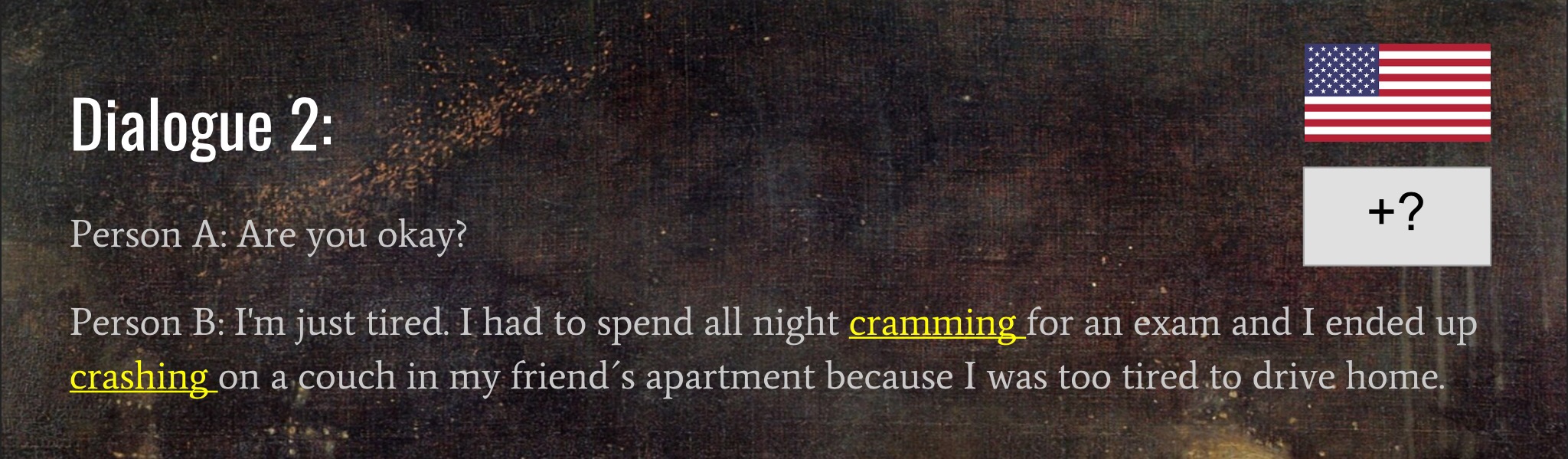
Overall, the lesson went well in both classes. The students seemed to like the lessons, but it was like pulling teeth to get my students to participate. It came to a point where I had to choose students to participate, which I hate doing. I felt confident after the lesson in my first class, but the professor mentioned that she wants the students talking more. One the other hand, after teaching the lesson in my second class, the other professor said she loved the lesson and to keep up the good work. So, in one breath I am not doing quite enough, but I also am. Although I have not completely determined my plan for this coming week, I am planning on getting the students to talk, talk, talk in order to please both professors. Although I felt pretty good about my lesson and despite my previous teaching experience, this just proves that there is always room to grow. I feel relieved to have gotten constructive feedback, too. Now I know what I should do to improve for the future. Although I am still figuring this teaching thing out, I am excited to give it a go again next week!

 The Book of Salamanca: Semester in Spain